Saudi Arabia’s FDI Growth: What Investors Need to Know About the Kingdom’s Investment Opportunity
Saudi Arabia’s FDI inflows rose by 33.5%. Behind the figures is a wider economic transformation, supported by investment reforms, sectoral opportunities and a long-term strategy to attract businesses
Saudi Arabia is continuing to strengthen its position as a destination for foreign direct investment (FDI). The latest annual figures from the General Authority for Statistics (GASTAT) show that foreign direct investment inflows reached SAR 159.1 billion in 2025, up from SAR 119.2 billion in 2024.
This represents annual growth of 33.5%, while the total stock of FDI in the Kingdom reached SAR 1.059 trillion by the end of 2025, an increase of 8.3%.
For international companies considering entering the Saudi market, these figures offer an important signal: investment activity is expanding across several areas of the economy, while the government continues to develop the policies and frameworks intended to attract foreign capital.
But what is driving this growth, which sectors are attracting investment, and what should international investors consider before establishing a business in Saudi Arabia?
Saudi Arabia’s FDI figures: The latest official data
GASTAT’s Annual Foreign Direct Investment 2025 report provides a clear picture of the scale of investment activity.
Key indicators include:
-
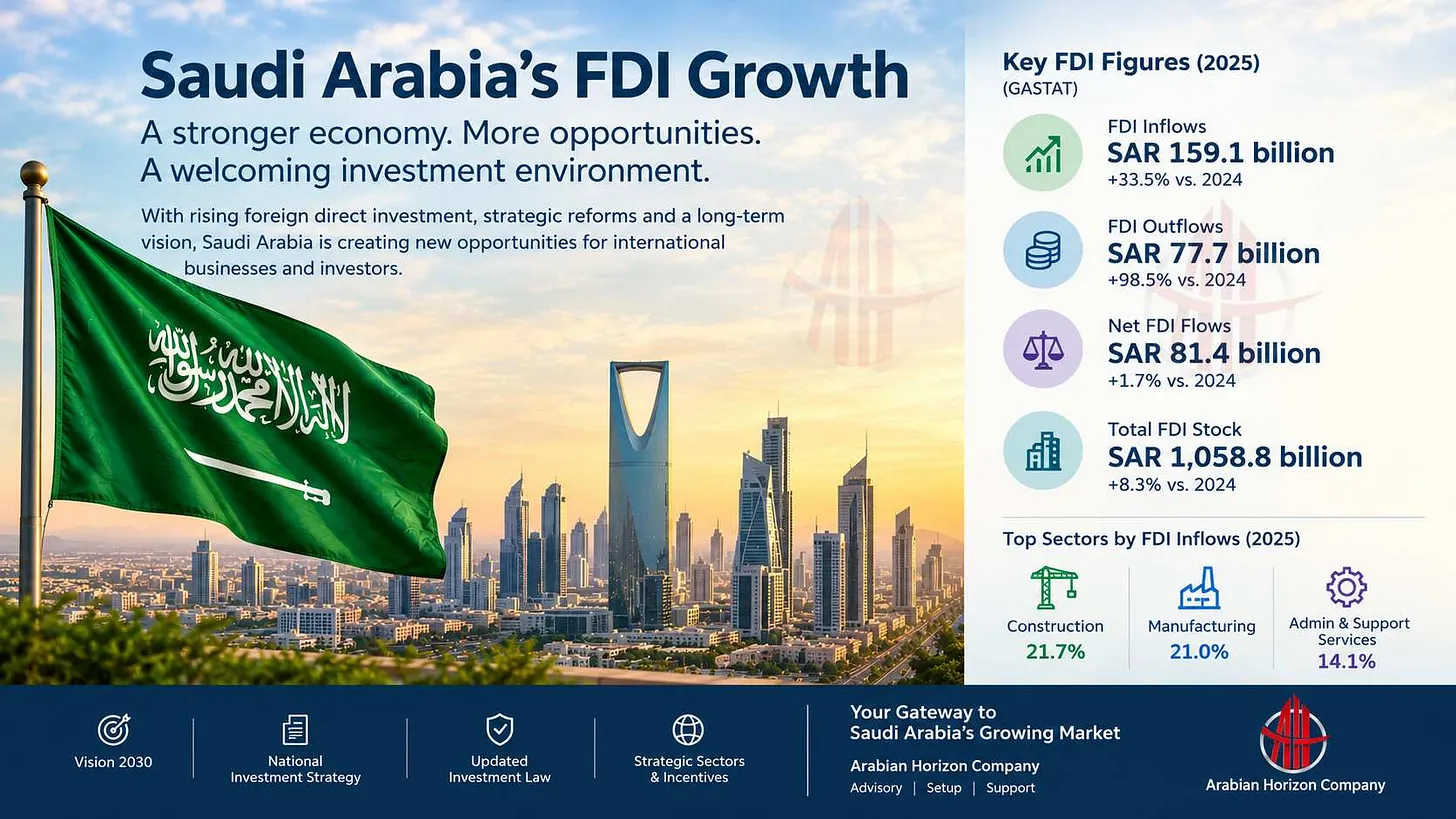
FDI inflows: SAR 159.1 billion in 2025, up 33.5% from SAR 119.2 billion in 2024.
-
FDI outflows: SAR 77.7 billion, up 98.5% from SAR 39.2 billion in 2024.
-
Net FDI flows: SAR 81.4 billion, compared with SAR 80.0 billion in 2024, representing growth of 1.7%.
-
Total FDI stock: SAR 1,058.8 billion at the end of 2025, up 8.3% year on year.
These measures describe different aspects of investment. Inflows represent foreign direct investment entering Saudi Arabia during the period, while outflows represent direct investment moving out of the Kingdom. Net flows reflect the difference between the two, and FDI stock represents the accumulated investment position.
The distinction matters. The 33.5% increase in inflows demonstrates a substantial rise in incoming investment, while the more modest growth in net flows reflects the simultaneous increase in outflows.
For investors, the overall picture is one of a large and expanding investment base, with continued opportunities to participate in the Kingdom’s economic development.
Which sectors are attracting foreign investment?
The 2025 GASTAT report shows that foreign investment is distributed across construction, manufacturing, services and other economic activities.
Construction led FDI inflows, attracting SAR 34.5 billion, equivalent to 21.7% of the total. Manufacturing followed closely, receiving SAR 33.4 billion, or 21.0%. Administrative and support service activities accounted for SAR 22.4 billion, representing 14.1%.
Other notable inflows included:
-
Wholesale and retail trade, including motor vehicle repair: approximately SAR 19 billion.
-
Professional, scientific and technical activities: approximately SAR 14 billion.
-
Financial and insurance activities: approximately SAR 10 billion.
These figures point to a range of potential entry points for foreign companies. Construction and manufacturing are prominent in the latest inflow data, while services, trade, finance and technical activities also feature in the investment landscape.
The accumulated FDI stock provides another perspective. By the end of 2025, manufacturing accounted for the largest share, at SAR 285.4 billion, or 27% of total FDI stock. Wholesale and retail trade accounted for SAR 157.7 billion (14.9%), while financial and insurance activities represented SAR 133.1 billion (12.6%).
For a prospective investor, these figures are useful starting points for identifying sectors to investigate. They are not, on their own, a guarantee of profitability or a substitute for assessing demand, competition, regulation and operating costs within a specific market.
Saudi Arabia’s investment policy: A long-term approach
FDI growth is taking place alongside Saudi Arabia’s wider economic transformation under Vision 2030.
Launched in 2016, Vision 2030 aims to diversify the economy, increase private-sector participation, develop new industries and create an environment that supports both local and international investors.
The National Investment Strategy is one of the frameworks supporting these ambitions. Its priorities include expanding investment opportunities, developing strategic sectors and improving the investment ecosystem. Official investment materials highlight areas such as technology, healthcare, green energy, advanced mobility, logistics and entrepreneurship.
The strategy also sets a long-term ambition to increase annual FDI inflows substantially by 2030. Saudi Arabia’s investment agenda is therefore not limited to attracting capital into existing industries; it also seeks to support the development of new sectors, capabilities and supply chains.
For foreign businesses, the practical significance is that market entry should be assessed in the context of these broader economic priorities. A company’s sector, capabilities and long-term plans may affect which opportunities and support channels are most relevant.
Updated investment rules
Saudi Arabia’s updated Investment Law came into force in February 2025, according to reporting by Arab News on the latest GASTAT figures. The reform is intended to streamline investment procedures and strengthen investor protections.
The law forms part of a broader effort to improve the investment environment. However, the rules and requirements that apply to an individual business depend on its activities, legal structure and other relevant factors. Investors should confirm the current requirements for their specific project rather than assume that a single process applies to every company.
Support for international companies
Saudi Arabia has also developed initiatives to encourage international businesses to establish a presence in the Kingdom. The Regional Headquarters Program, for example, is designed to attract multinational companies seeking to manage regional operations from Saudi Arabia. Qualifying companies may be eligible for specific incentives and support, subject to the applicable conditions.
These measures sit alongside wider investment-promotion efforts and sector-specific opportunities. Together, they reflect the government’s stated aim of making the Kingdom a more significant destination for international business.
For investors, the next step is to establish which rules, registration routes, licences and incentives actually apply to their intended activity.
Economic resilience and investor confidence
Investment decisions are influenced by more than growth figures. Investors also consider the ability of an economy to manage shocks, maintain essential activity and continue funding its long-term priorities.
Roberta Gatti, the World Bank’s chief economist for the Middle East and North Africa, highlighted Saudi Arabia’s fiscal capacity in an interview with Bloomberg on the sidelines of the IMF and World Bank annual meetings in Bangkok.
Gatti said that countries such as Saudi Arabia have significant financial capacity to use fiscal policy to mitigate economic shocks. She described the Kingdom as already doing so “very effectively.”
Her comments underline an important aspect of Saudi Arabia’s economic position: fiscal capacity can provide policymakers with options when external events put pressure on economic activity.
This does not mean that the Kingdom is insulated from regional instability, market volatility or other risks. Nor does fiscal capacity remove the need for businesses to assess their own exposure. It does, however, offer relevant context when considering the government’s ability to respond to economic challenges while pursuing longer-term development priorities.
For international companies, resilience should be one part of a broader assessment that also includes market demand, regulatory requirements, supply chains, financing and operational risk.
What does this mean for businesses looking to enter Saudi Arabia?
The rise in FDI inflows is encouraging, but the opportunity for any individual investor depends on how well a proposed business fits the market.
Before establishing operations, international companies should consider several practical questions:
1. Is there a clear market opportunity?
Research customer demand, competitors, pricing, procurement channels and potential local partners. National investment figures can help identify areas of activity, but they cannot establish whether a particular product or service will succeed.
2. What is the correct route to establish a business?
The appropriate legal structure, registration process, investment requirements and approvals depend on the proposed activity and the investor’s circumstances. These should be confirmed before committing significant resources.
3. Which licences and compliance requirements apply?
Investors should identify the relevant activity classifications, licences, permits and ongoing obligations. Requirements may vary by sector, so a general business setup checklist may not be sufficient.
4. How will the business operate locally?
A successful market entry plan should cover staffing, suppliers, premises, distribution, banking, contracts and local business relationships, as applicable.
5. Are there relevant investment programmes or incentives?
Companies should check whether their activities and structure qualify for any relevant programmes, incentives or support services. Eligibility should be verified against the current official terms.
Taking the time to answer these questions can help investors avoid unnecessary delays and build a more realistic plan for entering the Saudi market.
How Arabian Horizon supports investors entering Saudi Arabia
For international businesses, understanding the opportunity is only the beginning. Turning that opportunity into an operating business requires a clear understanding of the local environment and the practical steps involved.
Arabian Horizon Company helps businesses explore investment opportunities and navigate the process of establishing or expanding their presence in Saudi Arabia. Its expert services support companies seeking to understand their options, identify relevant requirements and approach market entry with a clearer plan.
Whether a business is assessing the Saudi market, planning a new establishment or looking for guidance on the steps involved in setting up locally, getting the right advice early can help clarify the process and identify the work that needs to be done.
Every investment is different. The most appropriate approach depends on the company’s sector, objectives and operating model.
For investors considering Saudi Arabia, the key is to move from general interest to a well-researched, compliant and practical market-entry strategy.
Looking ahead: Turning FDI growth into business opportunity
Saudi Arabia’s 2025 FDI figures show a meaningful increase in incoming foreign investment, with construction and manufacturing accounting for the largest shares of inflows. The total stock of FDI has also continued to grow, reaching more than SAR 1 trillion.
Alongside this growth, Vision 2030, the National Investment Strategy and investment-related reforms provide the policy context for the Kingdom’s efforts to attract international businesses and diversify economic activity.
These developments do not remove the need for careful due diligence. Instead, they give investors a stronger basis for investigating opportunities and deciding where their expertise, products or services may fit.
For businesses looking to invest or establish operations in Saudi Arabia, the opportunity begins with understanding the market, and building the right plan to enter it.
Arabian Horizon Company helps businesses navigate that process with expert support tailored to their needs.